Energy in Motion
Event Location: Orange County STEM Saturday
Competition: Energy Transfer Machine
Division: 6-8
School: Arbor Ridge K-8 Magnet Middle
Team Name: Soaring Eagles
Project Name: Energy in Motion
Team Size: 1
About Me :
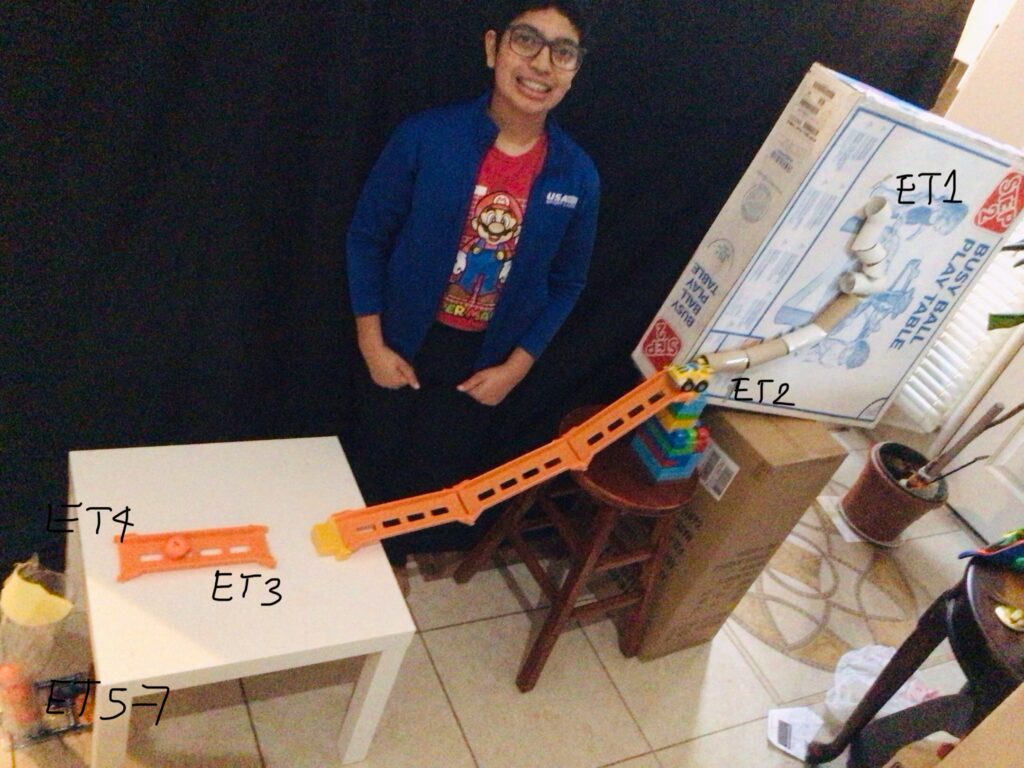
My name is Anay M. I am in middle school in 8th grade. While I have collaborated with Energy Whiz and related events for about 5 years now, including Junior Solar Sprint and Energy Inspired Art, this is my first time doing the Energy Transfer Machine event. I applied my knowledge from our science class’s energy unit, including new vocabulary like stored elastic energy, and gravitational potential energy. So, let’s dive in to this machine, its meaning and purpose, challenges, and what exactly defines it.
An energy transfer machine is a Rube Goldberg machine that uses multiple steps in a complex manner to do a task. For example, as Ann Novak describes “How can I use a marble to light a bulb?” (see References and Readings), the question might seem absurd but the purpose is to complete the task remotely (at a different site than where the first action happened, just like a car, the ignition control of the driver is separate from turning of the wheels). For me, it allowed me to problem solve and identify the problem to then think of methods I could fix the problem which I have mentioned on this webpage.
I identified the final “task” for the player to play the Happy Birthday tune. In order to do this, I incorporated multiple steps in my energy transfer machine. It is a mix of roller coaster (that I made), part of my car tracks when I was younger, some golf balls that I received as a donation and a snap circuit design with rechargeable batteries amounting to 3V which is less than the allowed 9V.
Given below are the initial sketch and energy transfer flow in my design (Artifact 1, Artifact 2) and the video explanations (Artifact 3a-c, explanation of the energy flow 3a-b, energy run 3c).
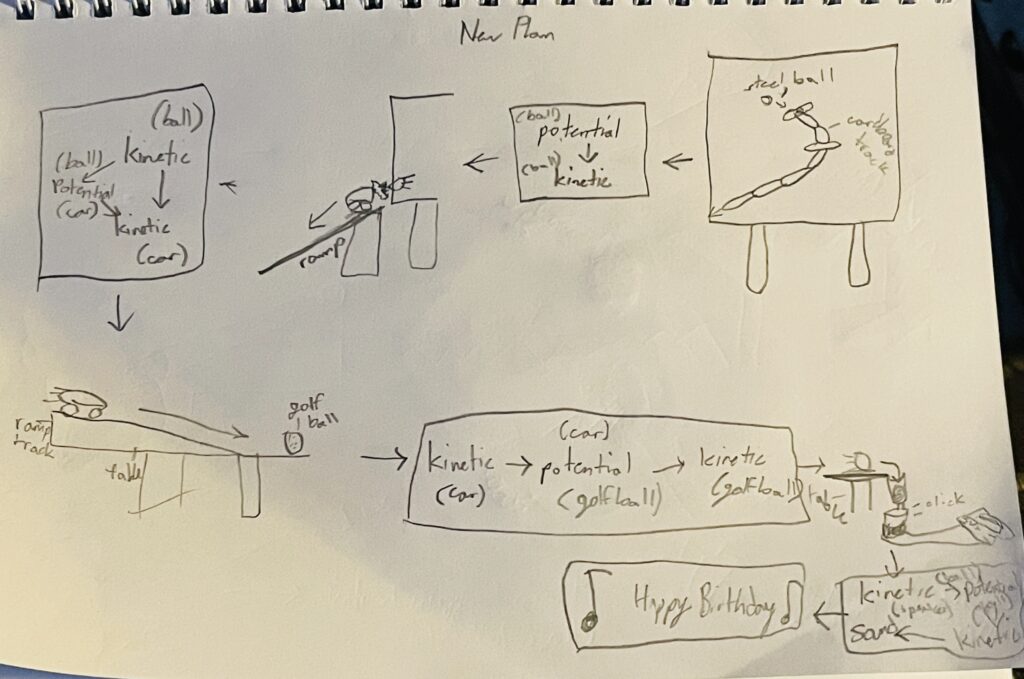
Artifact 1: Initial Sketch of the Idea
Given below are the materials used: I did not buy any materials for the project. I used/re-purposed recyclables, previously owned toys and donations from friends/neighbors.
- toy car and four of its tracks I own from my childhood
- one nickel ball from my knick-knack box
- three golf balls donated by a neighbor
- recyclables: 2 liter Pepsi bottle, paper towel roll holders
- Tape ($1.00 from Dollar Tree)
- Snap Circuit (previously owned toy, fair market value $7.99)
- rechargeable batteries (from home, $2.00)
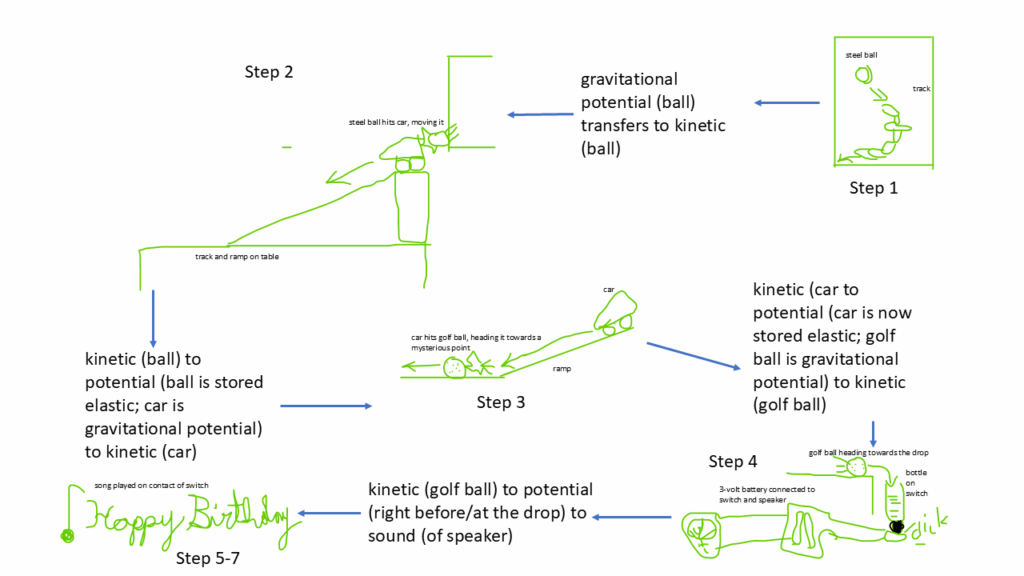
Artifact 2: Description and Energy Transfer Flow
Steps of the machine:
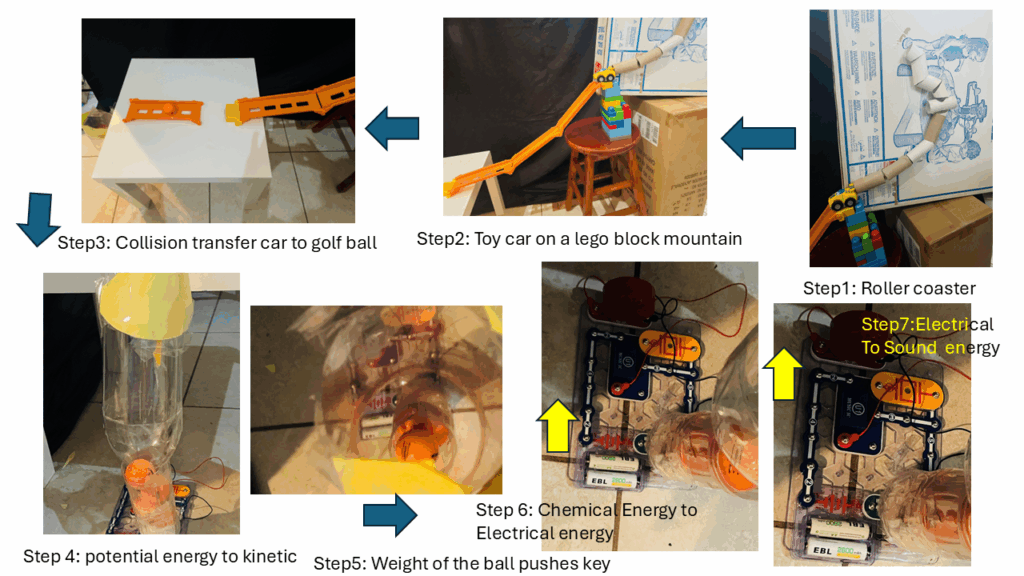
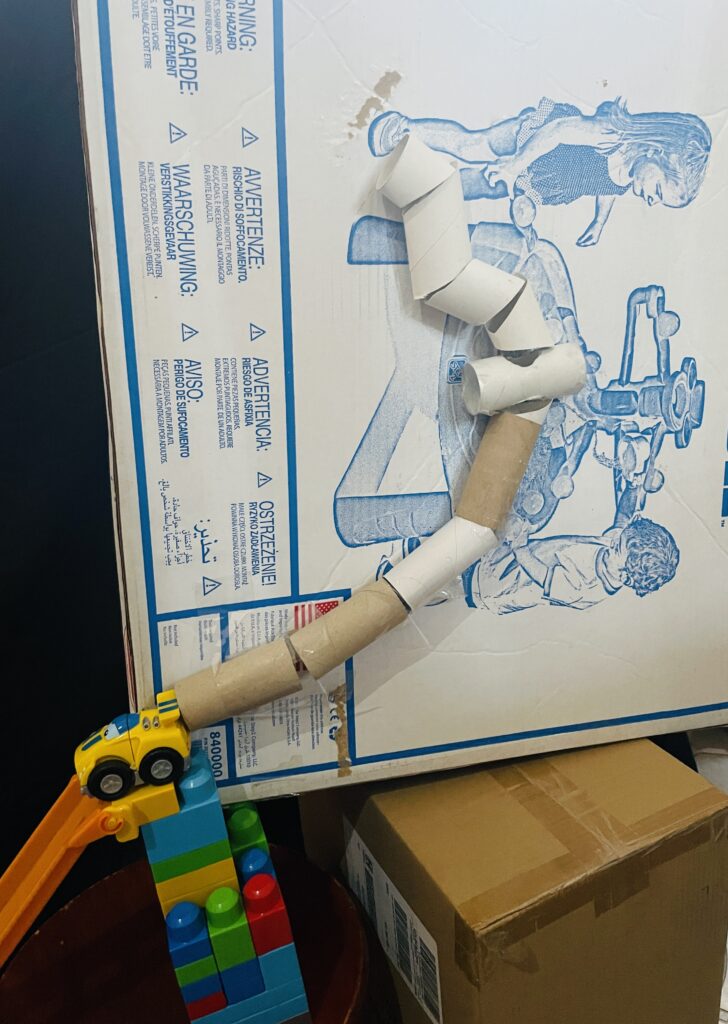
Step 1: The nickel ball is dropped into the roller coaster track, moving along the rolls and their walls until it reaches the car. The ball has gravitational potential energy when positioned at the apex height of the drop at the beginning. This potential energy is shifted to kinetic energy as the ball runs down the tracks.
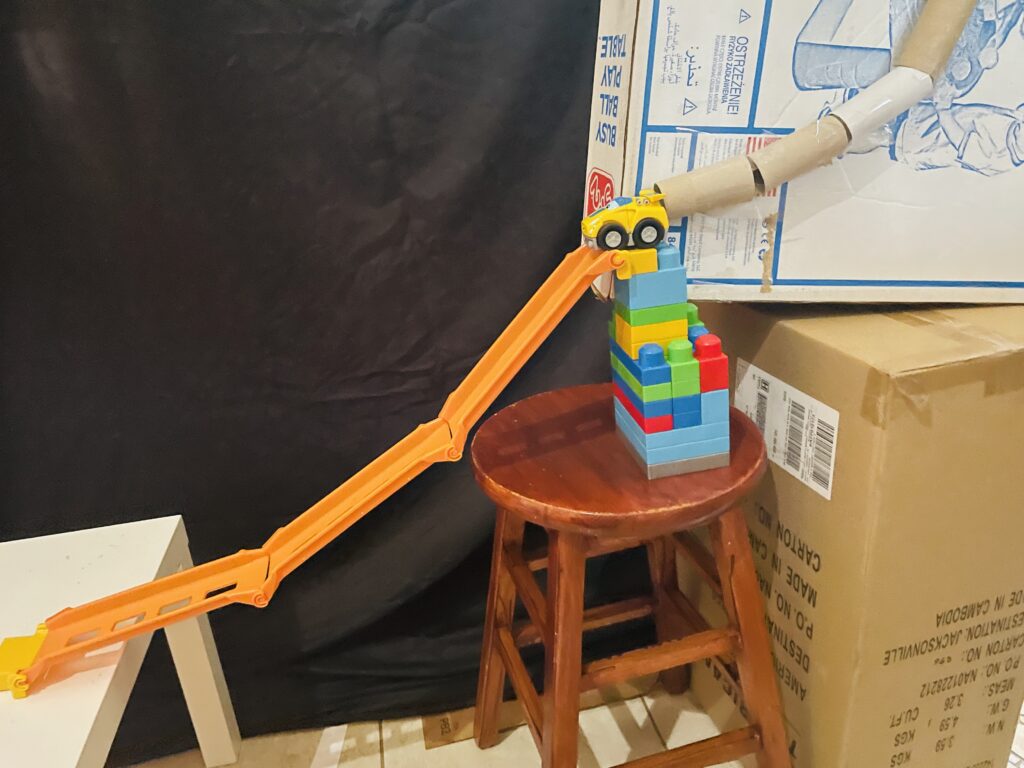
Step 2. The ball hits the car, moving it forward down a ramp and along a track. The ball’s kinetic energy becomes stored elastic energy during its impact with the car, when it flattens, then reforms. The car shifts from gravitational potential energy at the top of the ramp to kinetic energy thanks to the impact making motion happen.
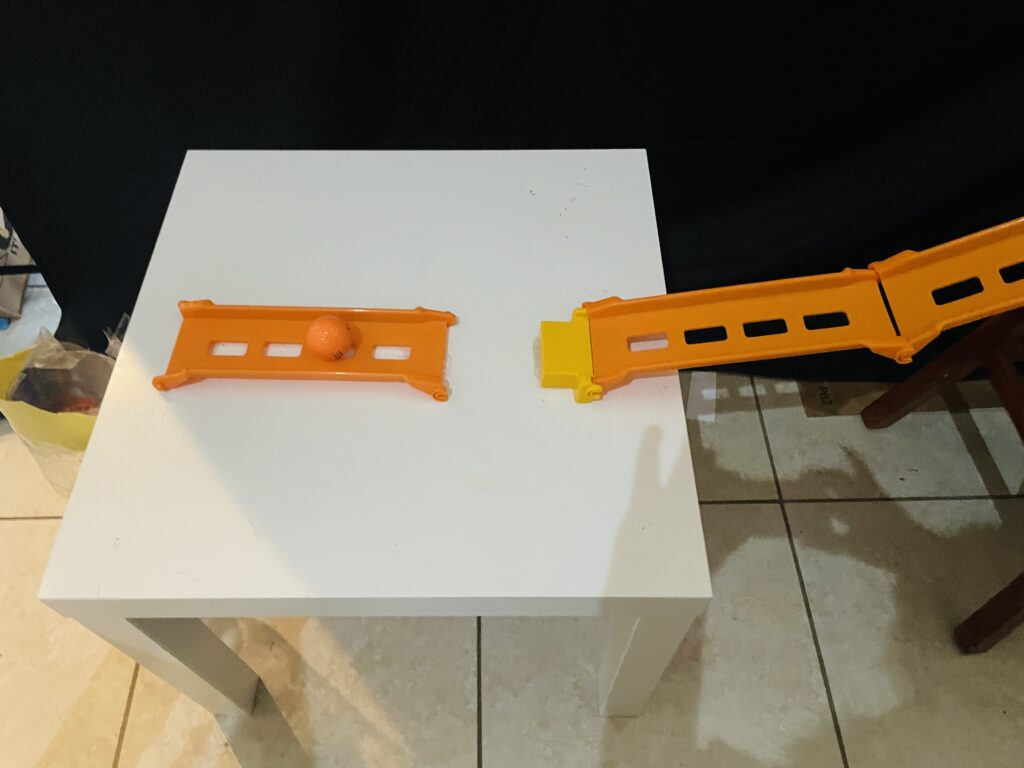
Step 3: The golf ball gets collided by the car, moving it forwards towards a drop. The car’s kinetic energy transforms into stored elastic energy on impact and the ball goes from gravitational potential energy to kinetic energy as it rolls closer toward the drop; this is similar but not the same to Step 2.
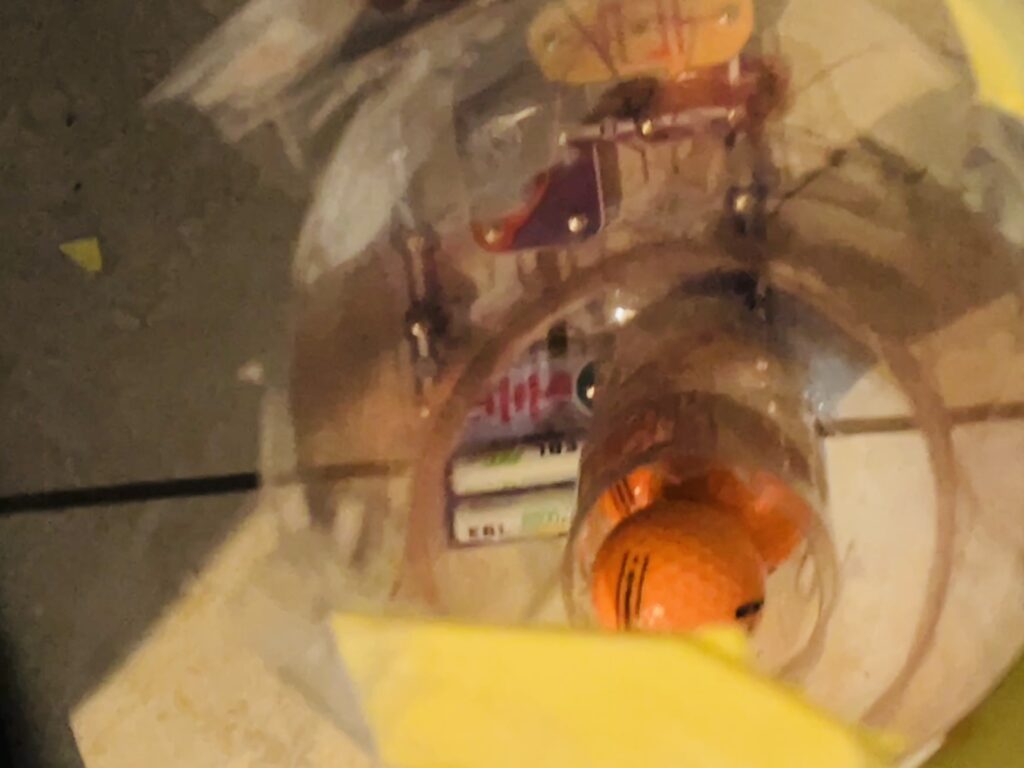
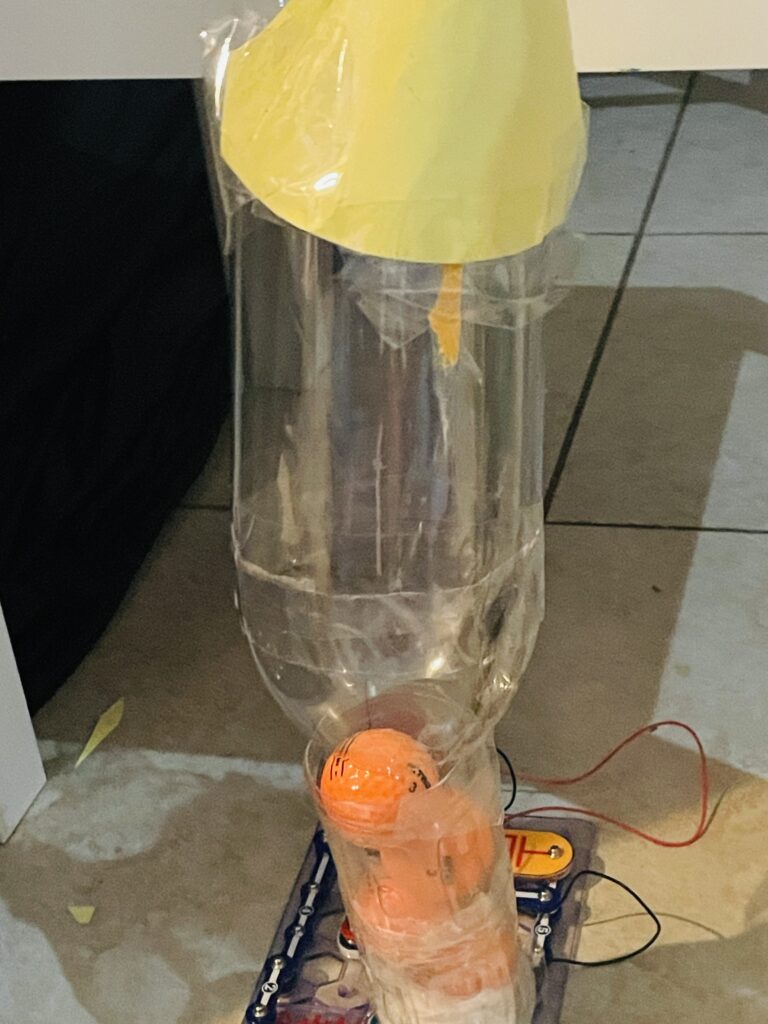
Step 4: The golf ball falls, converting potential energy at the top of the table to kinetic energy as it reaches the contraption container that sits on the key.
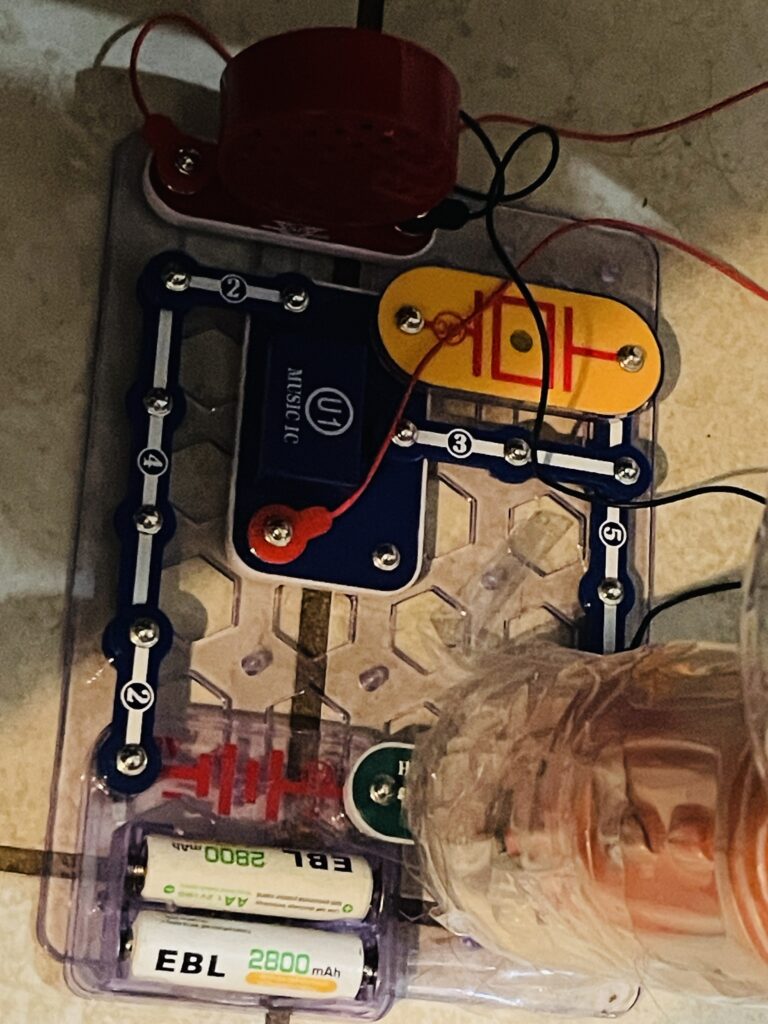
Step 5: The force and weight of the golf balls push the key and the mechanical energy in this action gets converted into the electrical energy since an electrical circuit is completed.
Step 6: The chemical energy stored in rechargeable batteries gets converted into the electrical energy.
Step 7: The active circuit allows the flow of electrons through the wires to the speaker where the music plays and electrical energy gets converted into sound energy.
Artifact 3a: Video Explanation of Energy Transfer at Each Step
Artifact 3b: Video Explanation of Energy Transfer at Each Step (part B)
Artifact 3c: Final Energy Run
Problems encountered: Solution Opted:
My initial design included solar energy; however, due to cloudy weather and logistics testing and experimentation became challenging.
The type of ball used to go through the roller coaster was debated.
The distance from the point of the drop was also debated.
The “funnel” to collect the ball was faulty.
The push button to close the circuit was a bit concave and would have to be held on for circuit to be complete for next transfer to occur.
I chose to use method that would allow me to test my design easily. Hence, roller coaster seemed like an useful replacement.
Experimentation and several runs allowed me to pick a nickel ball over a table tennis ball, a small plastic ball which did not have enough energy to push the car. Kinetic energy is dependent on both mass and velocity.
The distance of how much the ball rolls changes the energy it carries and had to be optimized.
I had to try different combinations so the ball always dropped consistently inside the contraption and allow for the next energy transfer.
I built a contraption with enough energy to stay in equilibrium such that any extra mass will tip the balance and complete the circuit.
Citations and websites referred/watched:
https://www.marissabellino.com/uploads/7/6/6/1/7661682/rube_goldberg_machine.pdf
https://sciencebysinai.com/stem-energy-project-using-rube-goldberg-machines-and-food-chains/
https://www.youtube.com/watch?v=fkwDtFkdB2E
https://www.youtube.com/watch?v=_8_n3uDUqd4
https://www.youtube.com/watch?v=YKrmffMtC6I
https://www.energywhiz.com/project/energy-transfer-machine-by-dhruv/
https://www.youtube.com/watch?v=OHwDf8njVfo
6 Close-Up Pictures of the Energy Steps